
It’s the motto of the Catholic secondary school I attended, St Mungo Academy (1968-1974), when it was nominally run by Marist Brothers though most of the staff were lay teachers. The previous four years I’d attended a Catholic primary boarding school, St Columba Preparatory College in Largs, where I was also taught by Marist Brothers.1
My school blazer had the Latin motto stitched into the school’s emblem, which was a Marian motif. But the Latin tag had nothing to do with Catholic theology or Marian worship. We boys (it was then a single-sex school) translated it facetiously as ‘no sign of work’, which our teachers corrected to ‘nothing without hard work, boys’. It was frankly uninspiring, a glum admonishment, or so we thought. Our Latin teachers referred to the origin of the tag but didn’t explore it as far as I recall; and I didn’t realise the full context until out of idle curiosity I traced it for myself as a student, when I had access to a humanities library at Glasgow University Library.
Hesiod, Works & Days, l.287 is maybe the earliest version, where it’s a straightforward comment on the hardships of life. But there’s another source, in Quintus Horatius Flaccus’ Satires, Book 1, 9 “Ibam forte Via Sacra,” l. 56ff (1.9.56-60):
Haud mihi dero:
muneribus servos corrumpam; non, hodie si
exclusus fuero, desistam; tempora quaeram,
occurram in triviis, deducam. Nil sine magno
vita labore dedit mortalibus
One of my favourite blogs, WIST, (Wish I’d Said That) gives many historical translations of this passage, which is part of a lethal satire on a hanger-on desperate to be part of the circle of Horace’s friend and rich patron, Maecenas – take your pick of the list of translations there. Here’s Burton Raffel:
“I’ll do it, I’ll do it! By god, I’ll bribe
His slaves, I’ll never give up, I’ll get
My foot in his door, somehow. I’ll watch,
I’ll wait, I’ll catch him in the street,
I’ll follow him home. Nothing worth doing
Is easy, here on earth!”
I remember that when I read Horace over against Hesiod the tag appeared in a different light – no longer a typical Hesiodic comment on life’s hardships but a portrait of social climbing, hypocrisy and corruption, where hardship consists in the cringing efforts of the speaker to break into elite social circles – the very opposite of Hesiod’s plain, country virtues. Was Horace satirising Hesiod as well as the speaker? Or was he commenting only on the state of Roman society of his day, full of social climbing and bribery? Possibly he was drawing on Hesiod as a comment on contemporary Rome, with the double irony of the desperate social climber drawing, without him knowing, on the unlikeliest of sources in Hesiod. What interpretation did the school take? No one said, as far as I remember.
To a tyro student of literature it was an interesting point, and had the personal dimension that I’d worn the school blazer with that motto on it for five years without really knowing much about it. But in later years, the resonances deepened as I discovered more about Horace and St Mungo’s. Horace wasn’t born into Roman elite society: he came from freed slave parentage, became a republican inspired by Brutus, fought at Philippi against the armies of the principate led by Octavian (later Augustus) and Mark Antony. He fled the field in the rout, and was given amnesty a short while later by Octavian and a civil service post in Rome that enabled him to spend time writing poetry. Later, after the circulation of the epodes and satires, he was given his famous rural home, the Sabine farm, by his patron Maecenas, a close friend of Octavian, and an able administrator and diplomat. Like the rest of his generation Horace had to negotiate the transitional politics from republican to early imperial Rome. He was well aware what was required of him as a civil servant and a poet to stay alive and thrive in a dangerous political climate – his own private version of that acute satire of social climbing.
Horace’s position, on the edge, marginal, needing also to participate in Roman society, that too was part of the educational culture of St Mungo’s. Founded in 1858, the Catholic school was set up by the Marist Brothers in the East End of Glasgow, amidst the poverty of Irish Catholic immigrants, encountering racist and sectarian discrimination in Glasgow. But the school was also not far from an ancient spot, the sixth-century dear green place by St Kentigern’s cell (Mungo is probably an affectionate name from Gaelic for Kentigern), beside the clear waters of the Molendinar burn as it flowed gently down towards the shallows of the broad Clyde.2
That imaginary was quite a contrast to my own experience as a schoolboy, though. The first two years at St Mungo’s were spent at the Kentigern annex, a grim Victorian corporation school building, sited beside the by-then polluted Molendinar burn in its foul concrete vennel. On one side of us on Duke St was the wreck of the Great Eastern Hotel, then a hostel for homeless men, and on the other a bonded warehouse beside a railway junction, giving off a sour stench. On the opposite side of the road from the school, the remains of the Duke St Prison. The very opposite of the St Mungo origin story, and a daily reminder of industrial poverty, economic oppression, ecocide.
In fifth year at school and first year at university I’d come across another school motto, αἰὲν ἀριστεύειν, be always the best, worn by pupils attending a private fee-paying school, Kelvinside Academy, on the other side of the city from St Mungo’s Academy. It was sited in the leafy West End, its neo-Greek architecture designed by James Sellars in 1878, in a quiet terrace of elegant houses, beside Botanic Gardens.3 Contemporaneously, Glasgow University moved from its medieval foundation in the High St just around the corner from the Kentigern annex, to the neo-Gothic splendours of Gilbert Scott’s new-built Gilmorehill site, a 15 min walk away from Kelvinside Academy. The famous Renaissance and eighteenth-century botanical gardens of the university, abandoned, became the site of warehouses, railway sidings and industrial wasteland that I walked past every day up the High St on my way to school.
For a Catholic boy the material contrast could hardly have been starker. It was evidence of the historical need for a Catholic academy that would enable boys to enter the professions and universities in the context of the narratives my father and grandfather told of workplace sectarian discrimination. In the 1970s, in the period of comprehensive school catchment areas, and without one designated to it, St Mungo’s became a selective academy, taking in boys on academic merit. Our headmaster Brother Kenneth made the religious and social contexts plain to us at assemblies; and success in university entrance, intellectual competitions, debating, football, rugby, running was keenly sought and praised. Leadership in a life of service was part of the school’s religious values, but muted by much more secular aims of materialist success in society.4
I was uneasy with that, and my incoherent rebellion took the shape of immersing in the Arts, and joining a group of around 10 or so refuseniks who didn’t take part in competitive team sports and instead went hill climbing with Brothers Robert and Alan.5 Weekends were spent in the mountains of the Arrochar Alps, the Trossachs and Glencoe and they climbed with us.6 We left behind competition, materialist success and for the last three years of school, mountains gradually became for me a third way between the East and West Ends of Glasgow.
Those days and weekends spent climbing were more profound than I knew at the time.7 When as a schoolboy I discovered from Robert Graves’ autobiography Goodbye to All That (reading it for background to his WWI poetry, but also because I wanted to find out how he could write his historical fiction about imperial Rome and the Eastern Empire) that he was a climber, and knew George Mallory it opened up networks of literature and nature for me that were new; but some of it was familiar too because of the shared experience of climbing.8
Nor was it escapism: it led us deeper into knowing ourselves. Our climbing team wasn’t a sport: it was a different experience altogether, much more encompassing of our lives. Instead of competition a fierce bond grew between us boys. We stood together in the school playground at breaks, talked about mountaineering. We followed the names in Scottish climbing, bought gear when we could afford it, learned navigation, hill craft, weather wisdom, topo history and culture, none of which were on the school curricula. Climbing helped forge us. On a snowy winter ascent of the Buachaille in Glencoe, led by an experienced climber who Brother Robert knew, we roped up on the Coire na Tulaich, learned to cut steps with ice axes in the frozen snow in those crampon-less days, moved cautiously up the edge of the steepening slope of the coire to the cornice, tenty of avalanche, knowing you needed the care, skill and quick action that we had practised so as not to bring down the roped others if you slipped. A summer week in the Cairngorms with high-level camping on the Cairngorm plateau on the shores of Loch A’an saw us, amongst much else, in one day walk the length of the loch, climb Ben Macdui, descend into the sombre wilderness of the Lairig Ghru and make the epic trek back along it to the far end of Loch A’an, sharing the last of our food and water, encouraging each other to keep going, arriving back at camp utterly exhausted and elated that we all made it back safely.
Climbing was learning – and not just knowledge of weather and ground, tools and their uses. Gradually it shifted my view of myself. I learned that I loved working intensively in a small chosen group, have done all my career, and work best in that culture. Years later I came across the concept of swift trust. I knew instantly what it was like, having experienced group formation based on performance in the hills; and how powerful it was. And not just in individual performance terms either, but in group forming, laying down memories, and passing on knowledge and just the sheer joy of an activity to others. When years later I took our two sons hill-walking up Ben Arthur and Narnain, I felt the ghosts of the climbing group from the 1970s gather around us on the trails.

Climbing and learning are both hard work but the dour sentiment of nil sine labore doesn’t say much about either. If the end of learning is about gaining entry to a profession, for yourself and a bourgeois life, it’s a reductive, impoverished end to it. And if you’re out for yourself first and foremost in learning according to the brutal code of αἰὲν ἀριστεύειν, the values of community and trust in academic, professional or indeed any occupation are lost. Both mottos fall short. Learning like climbing is a much subtler third way: it’s like joining a community of knowledge and skill; it’s a dynamic interaction between cognitive, emotional, social, and self-regulatory processes, all of which unfold in often unbidden, surprising ways across a person’s lifetime. Climbing taught me that, and I’m so grateful for it.
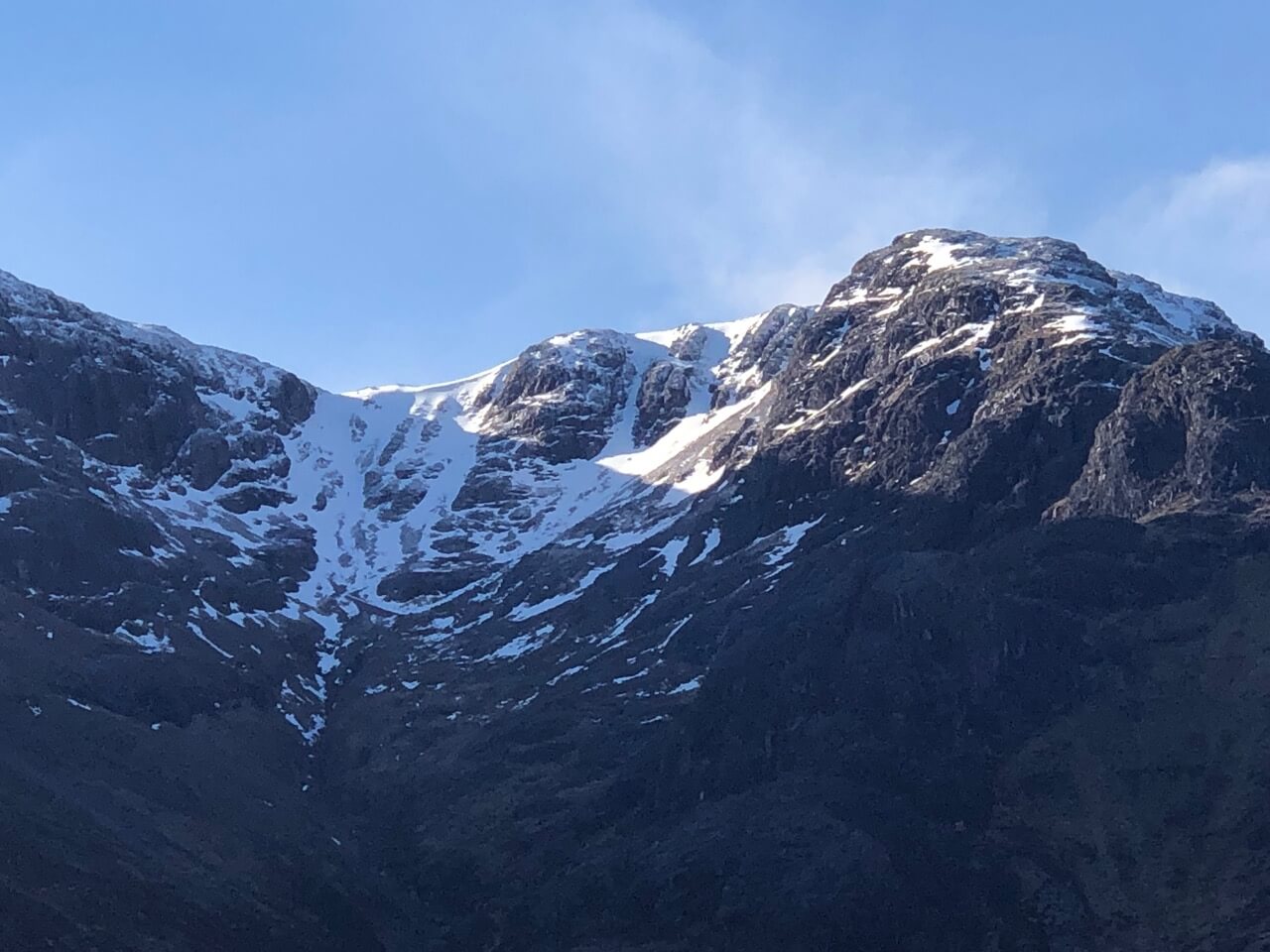
Stob Coire nam Beith, Glencoe. Photo courtesy of Euan Maharg (May 2026).
- Nine years of Catholic school education certainly left its marks on me. I was interested in the Humanities in primary school (see this post), and studied Latin & Greek at St Mungo. ↩︎
- If we can believe the twelfth-century Vita Kentigerni of Jocelin of Furness. ↩︎
- The source of the Greek tag is the Iliad, Book 6, lls119-211 – a battlefield dialogue between Glaucus a Lycian prince (one of Troy’s allies) and the Greek Diomedes, who face up to each other only to find, when they recite their ancestry to prove their identity as warriors and their worth as kills, that their ancestors knew each other and were friends; and so decide in honour of their kith to exchange pieces of armour instead of pieces of each other. Glaucus speaks the words: ‘Hippolochus […] fathered me, and from him I claim descent. He sent me here to Troy and charged me earnestly to be the best and bravest, and not bring shame on my ancestors the best men in Ephyre and all broad Lycia. Such is my lineage, from that blood am I sprung.’ (translation source) ↩︎
- At one school assembly in the freezing school yard Kenneth called me out in the mournful public-speaking voice he had, that implied a fall from grace, guilt-inducing. Jeeze, what had I done now. I walked up through the class lines to the front, to be presented by him with a prize from a Scottish schools poetry competition that I’d entered when studying at the Mitchell Library months before, more to break the boredom of exam study than from any other motive, and entirely forgotten about. The refusenik accepted, utterly abashed. ↩︎
- Years later I came across a passage from Foucault that said exactly how I felt:
‘Maybe the most certain of all philosophical problems is the problem of the present time, and of what we are, in this very moment. Maybe the target nowadays is not to discover what we are, but to refuse what we are. […] We have to promote new forms of subjectivity through the refusal of this kind of individuality which has been imposed on us for several centuries.’ Foucault, M. (1982). ‘The subject and power’, in: H. Dreyfus & P. Rabinow, Michel Foucault: Beyond Structuralism and Hermeneutics. Chicago, Chicago University Press, pp. 208–226, 216. The problem of ‘what we are, in this very moment’ was something that drew me to the work of Arendt. The passage was quoted by Jan Masschelein and Norbert Ricken in an article querying whether the concept of bildung was still useful to analyse developments in education discourse and action; or whether it were yet another concept that had was a specific power-apparatus: ‘an individualising (and immunising) apparatus’. (Masschelein, J., Ricken, N. (2003). Do we (still) need the concept of bildung? Educational Philosophy and Theory, 35, 2, 139-154) I disagree with them on that point largely because bildung is ceaselessly reinterpreted in educational theory and its power-apparatus is highly protean; but the immediacy of Foucault’s words described precisely how the young teenager Paul felt, if he’d been able to articulate it then. And in attempting to refuse what I was, I was also taking the first step to engage in bildung. ↩︎ - At first, we wore cheap workmen’s boots, canvas half-zip smock anoraks (a borrowing from Greenlandic word annoraaq, a hooded outer garment worn by Inuit – OED), canvas column ruksacks. Later we began to buy compasses, our own maps, proper climbing boots, hickory-shafted ice axes, we sweated in the new-fangled nylon cagoules, experimented with framed rucksacks, etc ↩︎
- And there was a summer holiday spent climbing in the Spanish Pyrenees, camping out in the grounds of an old Marist House beside a torrent, the peaks close by. I remember on a scramble being the last to abseil off a cliff, a thunderstorm breaking all around me, feeling terror and delight in equal measure, focusing on the wrap of the rope around me (classic abseil, no belay devices), and bouncing down the cliff. ↩︎
- Mallory was Graves’ teacher at Charterhouse, and took him climbing with others in Wales. ↩︎